Path to Invention
My very first game, Orbital Summation, was originally created to serve one purpose: I needed a reason to use my newly designed “Boulder Dice”. I explain how these dice are used in more detail on the Orbital Summation page.
As I developed Orbital Summation, I realized that it was actually quite fun and challenging to design new games. And so my passion took hold. But at the same time I began to rethink the Boulder dice. After some research I found that there were some very similar dice that had been invented years before. Plus they were a pain to build!
So I started playing around with new concepts. Now that I was making games that required eight-sided dice, I wanted something different from the ones offered in stores and online. Those dice are fine; there is absolutely nothing wrong with them. But still….
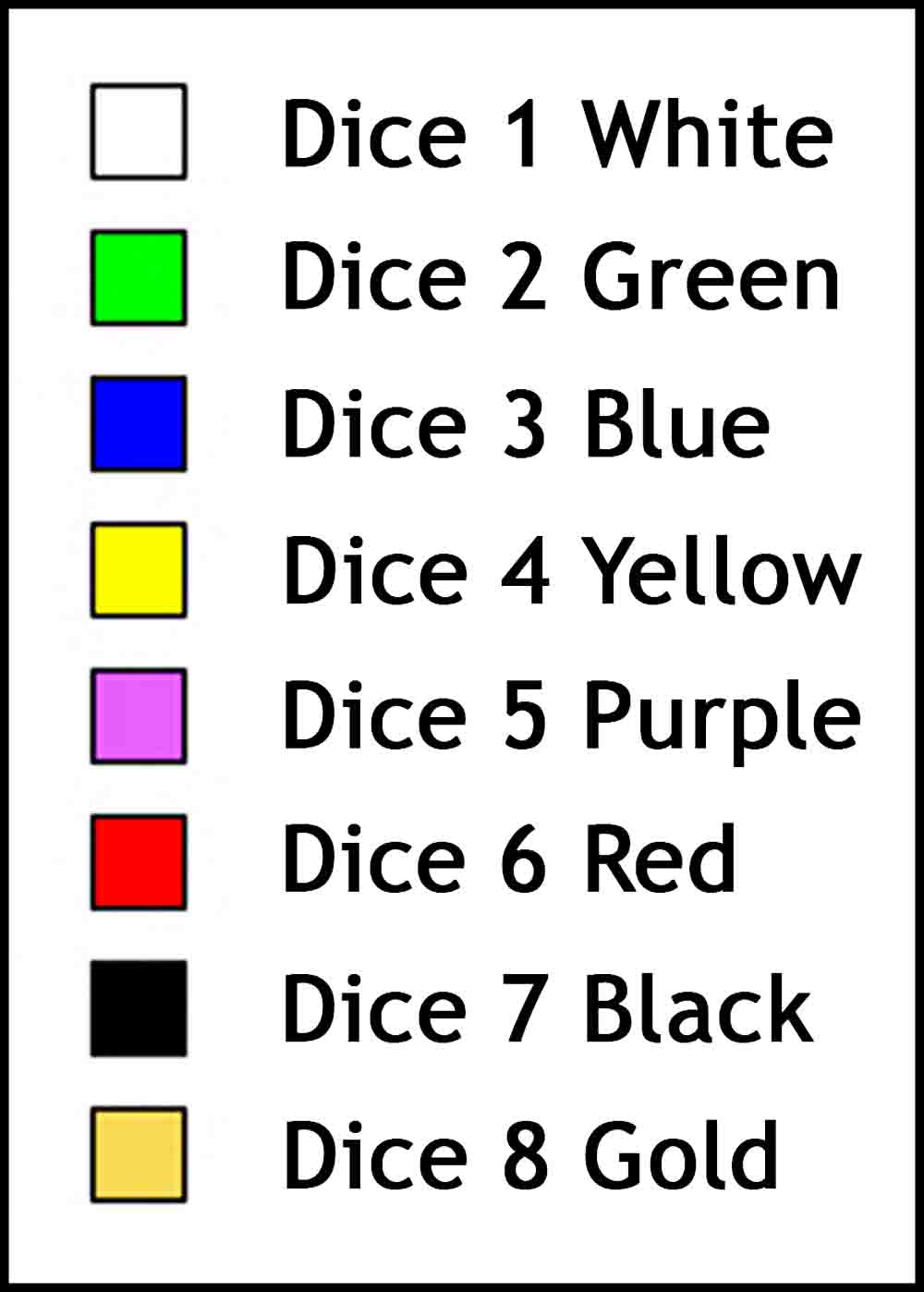
The easiest dice for me to make at that time were the simple ones I made out of PVC pipe. I basically cut off small sections of pipe, faced them off in a lathe, then milled eight equal sides on them. Soon I was engraving numbers on them instead of using a permanent marker. Then, as I developed the kids’ game Rainbow Raceway, which uses dice with both colors and numbers, I realized that I needed to assign each number from 1-8 a matching color. Green and white were my high school colors, so I started off with them. I worked my way up to gold, which became number 8.
Once that was settled on, I still wanted to find a new design for some dice. While playing around with regular 6-sided cube dice one day I realized one problem with conventional dice: they often ended up sliding off the table and onto the floor when being tossed by over-zealous players during a competitive game . That’s when I started studying the concept of dice being built with a slight taper to them. For example, if you toss a hex head bolt on a table it will start off sliding and then, once it quits sliding, it will roll in a circle until it stops. Of course, the slicker the table finish, the harder it is to quit sliding. Moderation is required. So, to make a long story short, I was soon making tapered dice and within a few years I acquired a patent on my design.
I tinkered around a bit with some different marketing ideas, as shown by two pictures below, but eventually I came to the conclusion that there needed to be a bigger demand for eight-sided dice in order to entice a company to invest in manufacturing them. I had to invent more games!
So I switched gears away from my dice and started working on different game ideas that were swirling around in my head. Other projects, especially the DynoDisc development, soon took much of my creative energy. Plus there is only so much time in a day, and it was hard to focus on one thing when trying to live a normal life with work and kids. I never really pursued selling my dice to anybody directly.
Since I have retired I have to acquire my dice – all of them eight sided – from other places instead of making them from scratch. Standard numbered dice may be purchased at some novelty stores but it may be easier to find them online. However, if you want to play right away, click the link below. One six-sided die will appear. Click on it and it will disappear. Next, click on the Purple 8 for as many dice as desired, then start rolling!
In the word game LetterLimo I have written a conversion chart for either using real numbered eight-sided dice or virtual numbered dice. So, most of these games are capable of being played almost immediately.
Virtual dice will work in a pinch, but there is something intensely satisfying of rolling dice in person, shaking them in your hands and sending them on their way, bouncing and clattering across the table. This especially holds true for young kids playing what may be their first board game, Rainbow Raceway! One grandson even knows how to say, “Shake them bones!”
As I mentioned previously, the dice in my games that use different colors, certain numbers, or have letters on them will probably have to be purchased and then modified with a magic marker or some hobby paint to finish them. An option for many people who own or have access to 3D Printers will enable that person to make all shapes and styles of eight-sided dice. And a person with some shop equipment and a CNC Milling machine can make some awesome dice, too!
Click the green button to see a list of my current games and their individual dice requirements.
Here are some pictures pertaining to dice I’ve made.




Soon after receiving my patent, I messed around with different names to make the tapered dice seem exciting. I thought they looked like small tornadoes, so I came up with these two ideas:


Spinner Dice Spinning